If you run a travel business with on-field employees, whether they are B2B sales executives visiting hotel partners, tour coordinators meeting clients, or field agents handling bookings across the city, you already know how hard it is to stay on top of their work. Calls go unanswered. Updates arrive late. Attendance records get filled in at the end of the day from wherever the employee happens to be sitting.
GPS tracking removes all of that uncertainty. It gives managers real-time visibility into where every field employee is, how long they spent at each location, and what route they took to get there. No calls required. No waiting until the end of day.
This article covers exactly how GPS tracking works for travel companies, what it actually improves, and what to look for when you decide to set it up for your team.
Field staff in a travel company do not work from a desk. They move constantly, covering hotels, corporate clients, travel agents, and event venues across a city or even multiple cities.
The problem is not that employees are untrustworthy. The problem is that there is no system to verify what happened in the field. A manager has no way to confirm whether a client visit actually took place, how long the sales rep stayed, or why they missed a scheduled meeting.
Most travel companies rely on one of three things: phone calls, WhatsApp updates, or end-of-day reports. None of these are reliable. A phone call disrupts the employee mid-visit. A WhatsApp message tells you nothing about location. And an end-of-day report reflects what the employee remembers to write, not necessarily what happened.
This visibility gap leads to real problems: missed client visits, inflated mileage claims, inconsistent follow-ups, and managers spending a large part of their day just trying to figure out where their team is.
According to research cited by Deloitte on field service scheduling, companies that use real-time tracking and telematics to manage field staff schedules can extend their productive working day by 20 to 30 percent. That number is significant for any travel business trying to get more done with the same team.
GPS tracking is not just a map with a dot showing where someone is. In a proper field staff management setup, it covers several practical functions.
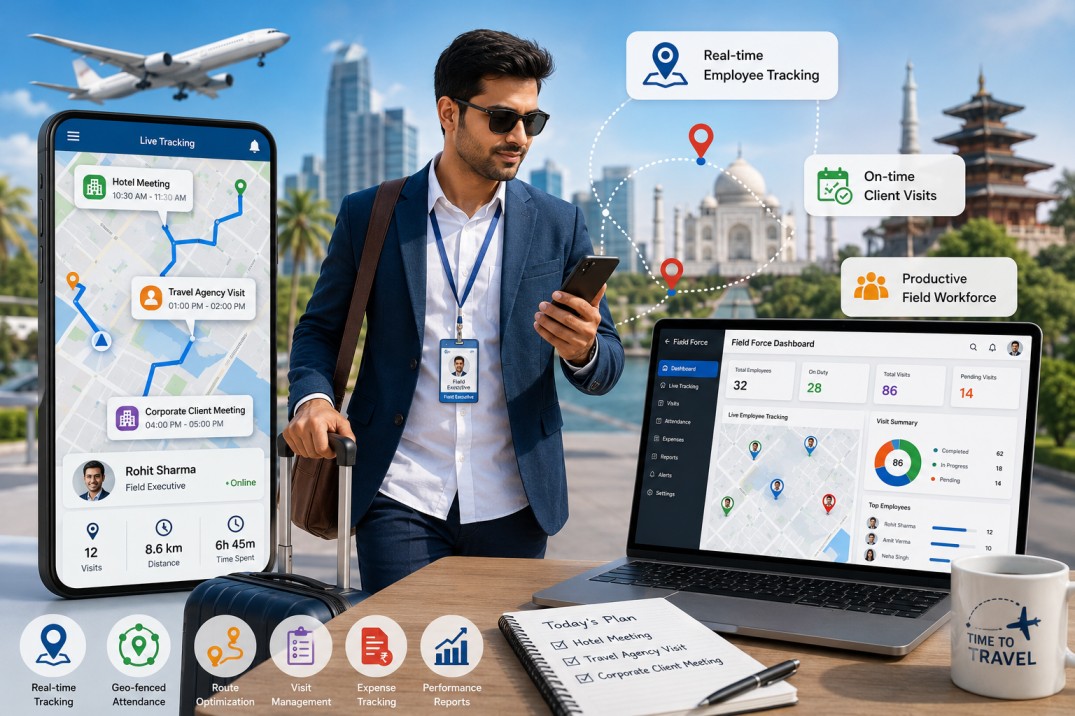
Real-time location visibility shows every field employee on a live map. A manager sitting in the office can see, at any point in the day, who is where and how far they are from their next visit.
Route history gives a full record of the path an employee took throughout the day, including stops, distances covered, and time spent at each location. This is especially useful when verifying whether a client visit actually happened.
Geo-fenced attendance means an employee can only mark themselves as present when they are physically at a verified location. This eliminates remote clock-ins and false attendance entries entirely.
Visit logs record timestamps and durations for every client meeting. Instead of relying on memory or a handwritten note, managers get an automatic record of who was visited, when, and for how long.
All of these functions work together without requiring any manual inputs from the employee beyond marking a visit start or using the app at check-in.
Picture this: your B2B sales executive has five hotel visits scheduled for the day. It is 3 PM and you have not heard from them. Did they cover all five? Did they skip one to go home early? Did they get stuck at the first visit and run out of time?
With a GPS tracking app, you do not need to call and ask. The live map tells you exactly where they are. The route history shows every stop they made. You can see at a glance whether they are on track or falling behind, and you can reassign tasks or adjust the schedule accordingly.
This alone saves managers significant time every day and removes the awkward dynamic of constantly checking in on employees.
Geo-attendance is one of the most immediately valuable features for travel companies with field teams spread across cities.
The way it works: an employee can only clock in when they are physically present at a geo-fenced location. If they are still at home, or at a cafe, or at the wrong address, the app simply will not register the check-in.
This replaces the common practice of employees marking attendance on their way to the location, or worse, from wherever they happen to be sitting when they remember to check in. Geo attendance systems verify the actual location at the exact time of clock-in, creating an honest and auditable attendance record without needing any manual verification from a manager.
For travel companies managing staff across multiple cities, this single feature makes attendance management far more reliable than any manual system.
One thing that becomes immediately visible once you start tracking route history is how inefficiently most field staff travel by default. Not because they are cutting corners, but because no one has ever sat down and optimized their routes.
An executive visiting clients in the same area might travel in a loop that adds an hour of unnecessary driving. Over a month, that is roughly 20 to 25 hours of wasted time per employee.
Once managers can see actual route data, they can suggest better sequences for daily visits. That extra recovered time translates directly into additional client visits per day, which compounds into more leads, more follow-ups, and more closed bookings.
According to field workforce management data published by AppIt Software, GPS route optimization reduces daily travel time by an average of 23 percent and fuel costs by 18 percent. For a travel company running a field team of 10 to 15 people, that is a meaningful operational saving.
In a travel sales environment, the follow-up is often what determines whether a booking closes or not. But follow-ups depend on accurate records of what was discussed during the visit.
A proper visit management system allows field staff to log notes, attach photos, record the client's feedback, and submit custom forms immediately after a meeting. This creates a real-time record that is accessible to the manager without waiting for a verbal debrief at the end of the day.
It also creates accountability for the quality of visits, not just the fact that they happened. If a client later complains that a rep never followed up on a promise made during a meeting, the visit log tells you exactly what was recorded at the time.
This kind of documentation is particularly valuable for travel companies managing corporate clients, where relationships depend on consistent and professional service across every touchpoint.
Mileage claims are one of the most common sources of friction between travel company management and field staff. Employees estimate rather than measure. Figures get rounded up. Managers approve amounts they cannot verify.
GPS mileage data solves this cleanly. The actual distance traveled is recorded automatically for every trip. When an employee submits an expense claim, the manager can cross-reference the claimed mileage against the GPS log without any confrontation.
Employees get fair reimbursements based on what they actually traveled. Companies stop paying for mileage that was never covered. And the entire process becomes faster because there is nothing to dispute.
This also applies to other field expenses. When an employee can attach a photo of a receipt to a visit log at the moment of purchase, expense reporting becomes a continuous process rather than a stressful end-of-month exercise.
At the end of a working week, most travel company managers either chase their field team for reports or rely on whatever gets submitted, which is often incomplete, late, or inconsistent.
A GPS-based field management system generates reports automatically. Visits completed, total distance covered, time spent at each location, attendance records, and task completion rates are all captured in real time and compiled without anyone having to write a single report manually.
Managers can review performance by individual employee, by region, or by time period. They can spot patterns, such as a rep who consistently completes fewer visits on Fridays or one who spends twice as long at certain clients compared to others. These patterns are impossible to see in manual reporting but become obvious once the data is being tracked consistently.
This shifts the manager's role from chasing information to actually using it.
Travel companies typically rely on one of several informal methods to track field staff. Here is how they compare.
WhatsApp Updates: Easy to fabricate and provide no location proof. A message saying "just finished the meeting at Hotel X" can be sent from anywhere.
Phone Check-ins: Disruptive for both parties, time-consuming for managers, and they only tell you where someone claims to be, not where they actually are.
Manual Attendance Registers: No field verification possible. An employee can fill in a register at any time and from any location.
GPS Tracking App: Real-time, verified, automatic, and non-confrontational. The data exists without anyone needing to ask for it.
The distinction matters not just for accuracy but for the relationship between management and field staff. When data is collected automatically and transparently, it removes the adversarial dynamic that comes with constant manual check-ins.
GPS tracking works well when it is set up thoughtfully. It creates problems when it is not.
The most common mistake is introducing tracking without any explanation to staff. Employees who do not understand why they are being tracked or what the data will be used for will assume the worst. According to a workforce survey by Timeero, 75 percent of field workers say they are comfortable with GPS tracking at work. The primary reason for resistance, when it does occur, is poor communication from management rather than the tracking itself.
A second common mistake is using tracking data only for negative purposes. If the only time an employee hears about their location data is when something went wrong, tracking becomes associated with punishment. It should be used equally for recognizing good performance and identifying employees who need support.
Third, many travel companies choose tools that are too complex for daily field use. If an employee needs to navigate five menus to log a visit, they will stop using the app consistently. The tool needs to be simple enough that using it correctly takes less effort than not using it.
Finally, some companies start tracking without a written policy. Even a basic document explaining what is tracked, how data is stored, and how it will be used goes a long way in building trust with the team.
Not every GPS tracking tool is built for the realities of travel company field operations. Here is what actually matters when evaluating options.
Real-time location updates, not delayed pings. Some apps update location every 5 to 10 minutes, which is adequate. Others have delays of 30 minutes or more, which makes the live map nearly useless.
Geo-attendance with a genuine location lock. The app should require physical presence at the location, not just proximity within a broad radius that could be satisfied from a car parked outside.
Visit check-in with timestamps, notes, and form submissions. The visit record should capture everything relevant in one place, so field staff are not jumping between multiple apps.
Route history and mileage reporting that are accurate enough to use for expense reimbursement without requiring manual corrections.
Mobile-first design built for field use. The app will be used on a smartphone, often in the middle of a meeting or while walking between locations. It should be fast, intuitive, and require minimal taps to complete common actions.
Integration with attendance, expense management, and CRM functions. A standalone GPS app that does not connect with the rest of your operational tools creates more work than it saves. The best solutions handle field force management end to end, covering location tracking, attendance, visits, leads, and reports from a single platform.
UpTeams is a field staff management platform trusted by more than 2,500 teams across industries, including tours and travel businesses managing on-field sales and coordination staff.
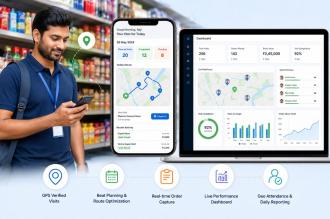
For travel companies specifically, UpTeams covers the core functions that matter in a distributed field operation. Geo attendance ensures that staff can only clock in from verified locations, eliminating remote check-ins. Real-time location tracking gives managers a live map of every field employee without requiring a single phone call. The visit management feature allows reps to log client meetings with timestamps, notes, and supporting photos directly from the app.
Beyond tracking, UpTeams includes lead and customer management for B2B travel sales teams, expense reporting with receipt attachments, and custom forms that can be configured for any client feedback or site inspection process your business uses. Tours and travel businesses can manage bookings, corporate visit scheduling, and field team performance all from one platform.
Reports are generated automatically, so managers can review daily, weekly, or monthly field activity without chasing anyone for updates.
If your travel company has a field team and you want to manage their work more accurately without adding administrative overhead, UpTeams offers a free trial to get started.
Managing field staff in a travel business does not have to depend on trust alone. Trust matters, but it works better when it is backed by a system that gives everyone clarity: employees know their work is being recorded fairly, and managers know what is actually happening in the field.
GPS tracking is not about watching people. It is about building a structure where every client visits, every working hour, and every kilometer traveled is captured accurately. That structure reduces conflict over expenses, improves daily visit coverage, and gives management the data they need to make better decisions about their field team.
The results are practical. More visits per day. Fewer missed follow-ups. Accurate attendance. Transparent expense records. And reports that exist without anyone having to write them.
UpTeams was built for exactly this, giving travel businesses and field-heavy teams a single platform to manage their people without friction, from real-time tracking to visit logs to automated performance reports. It is the kind of tool that pays for itself within the first month, simply by giving managers visibility they never had before.
Start your free trial today