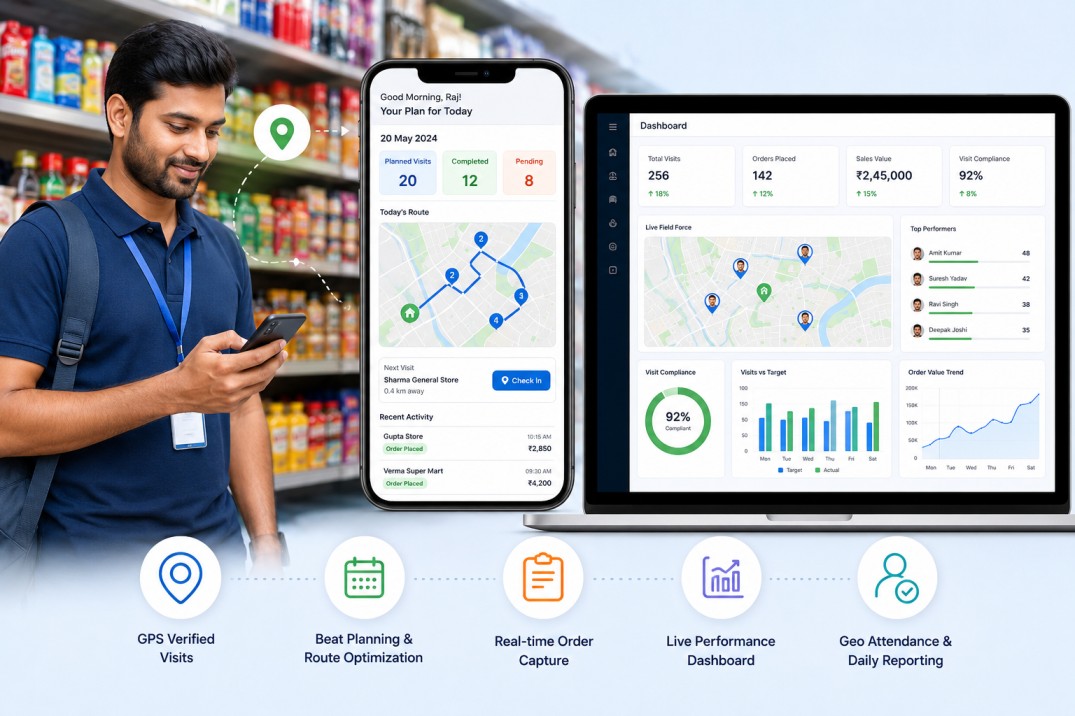
FMCG companies can track their field sales teams efficiently by combining GPS-verified attendance, structured beat planning, real-time order capture, and performance dashboards in a single mobile-first system. Without this, brands lose revenue to ghost visits, fake attendance, missed outlet coverage, and decisions made on data that is two days old. This article covers what efficient field tracking actually means, which features matter, what kills productivity when tracking is missing, and how to roll it out properly.
Ask any regional sales manager in an FMCG company what their biggest frustration is. Most will tell you the same thing: they have no real idea what their field reps are doing between 10 AM and 5 PM.
Reps call in with updates. WhatsApp messages pile up. At the end of day, someone fills in a spreadsheet. By morning, the manager has a picture of yesterday that may or may not be accurate. And the cycle repeats.
According to the Salesforce State of Sales Report 2024, sales reps spend only 30% of their time actively selling. The remaining 70% goes to admin work, manual data entry, and internal coordination. In FMCG, where margins are thin and outlet coverage is everything, that gap is expensive.
Ghost visits are a real problem. A rep logs 15 outlet visits for the day. In reality, 5 of those happened and the rest were filled in while sitting in a tea stall. The manager finds out two weeks later, if at all. By then, a competitor's rep has already covered those outlets and secured shelf space.
This is not an isolated issue. It happens across small regional brands and mid-size FMCG companies at scale. The problem is not the people; it is the absence of a proper field tracking system.
There is a common misunderstanding here. Many managers think tracking means putting a GPS pin on a rep's location. That is useful, but it is only one piece of the picture.
Efficient field sales tracking in FMCG means knowing four things at any point in the day:
Activity compliance — Did your reps visit the right outlets, in the right sequence, with the right visit purpose?
Order accuracy — Was the order placed correctly at the outlet? Was the right scheme applied? Was it captured in real time or filled in later?
Attendance verification — Did the rep actually start their day where they said they did, or was attendance marked from home?
Performance accountability — How does each rep's actual outlet coverage compare to their target? Where are the gaps by territory and by product?
In FMCG, your field salesforce is your fastest link between your brand and the retailer. They carry your pricing, your scheme information, your new product launches, and your relationship with the shop owner. If their activity is unverified and their data is unreliable, your entire market intelligence is compromised.
Not every tracking tool is built for the FMCG ground reality. Here is what actually matters in the field:
GPS-Verified Check-ins and Geo-Fencing
Geo-fencing technology allows reps to check in only when they are physically within the approved outlet's radius. This single feature eliminates the majority of ghost visits without requiring any confrontation or manual verification.
A rep cannot mark a visit to a retailer in Chandkheda if they are sitting in Bopal. The system flags it automatically. The manager sees it in real time.
Route Planning and Beat Optimization
Beat plans should not be static documents created once a quarter. A proper field tracking system assigns daily routes based on outlet priority, order history, territory load, and coverage gaps. Reps get their beat list on their phone each morning. Managers can see route adherence throughout the day.
Optimized route planning reduces travel time, increases the number of productive outlet visits per rep per day, and lowers fuel costs. Industry data shows that AI-based route optimization can reduce travel costs by 25% and increase outlet visits by up to 18% per rep.
Offline-First Mobile App for Order Capture
This one is non-negotiable for anyone operating in Tier 2 and Tier 3 markets. Connectivity is unreliable. If your tracking app requires a constant internet connection, reps will skip logging orders in the field and fill them in later from memory. That defeats the entire purpose.
A good field sales app works fully offline. Visit logs, order entries, attendance, and notes are captured on the device and synced automatically when connectivity returns. The data is accurate because it was entered at the moment it happened.
Live Manager Dashboard
Managers should not wait until 6 PM to find out how the day went. A live dashboard shows visit status, order volumes, rep locations, and target progress across the entire team in real time.
This shifts the manager's role from data collector to decision-maker. Instead of spending the evening calling every rep to compile a report, the manager can use that time to coach a rep who is falling short, redirect someone to a high-priority outlet, or respond to a distribution gap before it affects stock availability.
Geo Attendance and Daily Reporting
Geo-based attendance tracking captures the rep's start location, work hours, and field movement automatically. Attendance cannot be marked from home or a nearby location. Leave management and expense claims sit in the same system, reducing the paperwork load on both managers and HR.
Order Management Directly from the Field
When reps book orders through a mobile app at the outlet, order accuracy improves dramatically. The rep sees the correct scheme for that outlet, selects products, enters quantities, and confirms. There is no transcription error, no scheme confusion, and no delay in the order reaching the distributor or backend team.
A proper order management feature ensures that every order placed in the field flows directly into the system, with full visibility from the manager's dashboard.
Many FMCG companies start with a basic GPS tracker, realize it solves only one problem, and then go looking for something better.
A GPS tracker tells you where your rep is. That is useful but incomplete.
A proper field force management system tells you where they are, which outlet they visited, how long they stayed, what order they placed, which scheme was applied, whether the visit purpose was completed, what the retailer's feedback was, and how that rep is tracking against their monthly target.
The difference is the difference between surveillance and operational clarity. One tells you a location. The other tells you whether your business is growing or shrinking at the outlet level.
Sales Force Automation (SFA) connects field activity directly to sales outcomes. Attendance, visits, orders, collections, distributor coordination, and reporting all sit in one system. Managers and reps stop wasting time on parallel tools, WhatsApp chains, and end-of-day calls that exist purely to collect data that should have been captured automatically.
Put a number to the problem and it becomes very clear.
Consider a mid-size regional FMCG brand with 15 field reps covering a territory across multiple districts. Ghost visits reduce field productivity by 30%. Wrong scheme application at outlets causes margin leakage. Cash collection mismatches go unreconciled for weeks. Connectivity issues in Tier 2 towns mean orders are missed or delayed.
None of this shows up clearly in a weekly sales report. It shows up slowly, in lower secondary sales numbers, in distributor complaints, and in retailers who quietly start buying from a competitor whose rep actually shows up every week.
The FMCG market is expected to grow by USD 456.9 billion at a CAGR of 3.2% between 2024 and 2029, according to Infiniti Research, with over 49,000 companies competing for shelf space. More SKUs, more brands, and more reps are fighting for the same retailer's attention. The brands that have clear ground-level data move faster and win more shelf space.
A field tracking system is not an overhead cost. It is what makes the rest of your sales investment work.
Rolling out a field tracking system without a plan usually ends in low adoption and wasted budget. Here is a practical approach that works:
Step 1: Map your territories and beat structures first. Before any tool is selected, document your outlet universe, territory boundaries, and expected visit frequencies. A tool can only enforce a beat plan if that plan exists in the first place.
Step 2: Define what you want to track. Be specific. Is it just attendance and location? Or do you need visit management, order capture, expense tracking, and manager dashboards? Clarity here determines which features are non-negotiable in your selection.
Step 3: Select a mobile-first system with offline capability. For FMCG operations in India, offline functionality is not optional. Evaluate tools based on how they handle data capture when there is no signal, not just when there is.
Step 4: Train reps with a short, practical onboarding. Adoption fails when the training is a long manual nobody reads. A one-day onboarding focused on the three to four daily actions a rep needs to perform is enough to get teams started.
Step 5: Set up manager dashboards and KPIs before going live. Managers need to know what to look at before the data starts flowing. Define the metrics that matter: outlet coverage rate, order strike rate, attendance compliance, collection efficiency. Set them up in the dashboard in advance.
Step 6: Pilot with one region before scaling. Run the system with one team for three to four weeks. Document what breaks, what confuses reps, and what managers actually use. Fix those gaps before rolling out company-wide.
Step 7: Use the data weekly to coach and improve. The most common mistake after a successful rollout is letting the dashboard become wallpaper. Use the weekly data to run structured rep reviews. Which outlets are being missed? Which territories are underperforming? Which reps need route adjustments?
With a proper visit management system in place, managers should be monitoring these numbers every day:
Outlet coverage rate — Planned visits versus actual completed visits, by rep and by territory. This is the simplest measure of whether your beat plan is being executed.
Order strike rate — Of the outlets visited, how many resulted in an order? A falling order strike rate usually points to either a product availability issue or a rep who is not having the right conversation at the outlet.
Average order value — Tracked by rep, by territory, and by product category. Declines here often signal a competitor's promotion, a pricing issue, or a scheme not being communicated correctly.
Collection efficiency — Outstanding payments and collection progress. Cash leakage in FMCG is significant when left unmonitored, especially in markets where credit terms are informal.
Scheme compliance rate — Are reps applying the correct promotional schemes at each outlet type? Wrong scheme application is both a margin problem and a retailer trust problem.
Attendance and time-on-field — Not just whether the rep showed up, but when they started, when they ended, and how much of their day was spent in productive field activity versus transit.
According to McKinsey's 2024 Sales Effectiveness Study, companies that focus on tracking and improving high-impact field activities outperform peers by 20% in revenue growth. The metrics above are exactly those high-impact activities.
Even companies that invest in the right tools make these mistakes:
Tracking location but ignoring activity quality. A rep can physically stand inside an outlet for 2 minutes, mark a visit, and leave without doing anything productive. Location data alone does not tell you this. Visit purpose, order placed, and retailer feedback fields close this gap.
Picking enterprise software that does not work offline. Large SFA platforms built for urban markets often assume consistent connectivity. If your reps work in smaller towns, test offline performance first.
No manager training on how to read the dashboard. Reps are trained on the app; managers are handed a dashboard login and expected to figure it out. This creates a system where data is captured but never acted on.
Treating the system as surveillance rather than a support tool. Reps who feel monitored but not supported will find workarounds. The framing matters. A field tracking system should be positioned as a tool that removes admin burden, helps reps plan better routes, and gives them clear targets.
Skipping the pilot phase. Scaling to 50 reps on day one, before testing with a small team, almost always results in a messy rollout and low adoption.
The FMCG market employs over 14 million people globally. In India alone, thousands of regional brands have expanded their field teams significantly over the last three years. Competition at the outlet level has never been more intense.
Retailers are also more demanding. They expect reps to arrive on schedule, carry accurate scheme information, and process orders without delays. Brands that cannot deliver this level of execution lose shelf space to those that can.
A Gartner 2025 report on field operations found that companies using real-time data analytics in field work boost decision-making speed by 40% and increase revenue by 15%. The advantage is not theoretical. It compounds over time as data improves beat plans, coaching improves rep performance, and outlet relationships grow stronger.
The brands investing in field tracking today are building an operational edge that takes years for competitors to replicate.
Everything in FMCG depends on what happens at the outlet. The distributor relationship, the retailer stocking decision, the scheme execution, the new product placement, the competitor counter-response. All of it flows through your field reps.
A field tracking system does not replace their judgment or their relationships. It removes the friction that keeps them from doing their best work. Reps spend less time filling out reports, managers spend less time chasing updates, and the entire sales engine moves faster because everyone is working from the same real-time picture.
If your team is still running on WhatsApp updates and end-of-day spreadsheets, the cost is real, even if it is not visible on a single day's report.
UpTeams is built specifically for field teams like yours. The FMCG field sales app covers GPS attendance, outlet visit tracking, order management, beat planning, live manager dashboards, and daily reporting in one mobile-first system that works with or without internet connectivity. Trusted by 2,500+ teams across India, UpTeams gives FMCG companies the ground-level visibility they need to execute faster and grow distribution efficiently.
Start your free trial or book a demo to see how it works for your team.
Managing FMCG field teams becomes easier when every outlet visit, order, attendance record, and sales activity is tracked in real time. UpTeams helps FMCG companies verify outlet coverage, optimize beat plans, capture orders from the field, monitor team performance, and reduce reporting delays through one mobile-first platform. Give your managers the insights they need, your sales reps the tools they need, and your business the visibility required to grow distribution and improve execution.
Start your free trial today