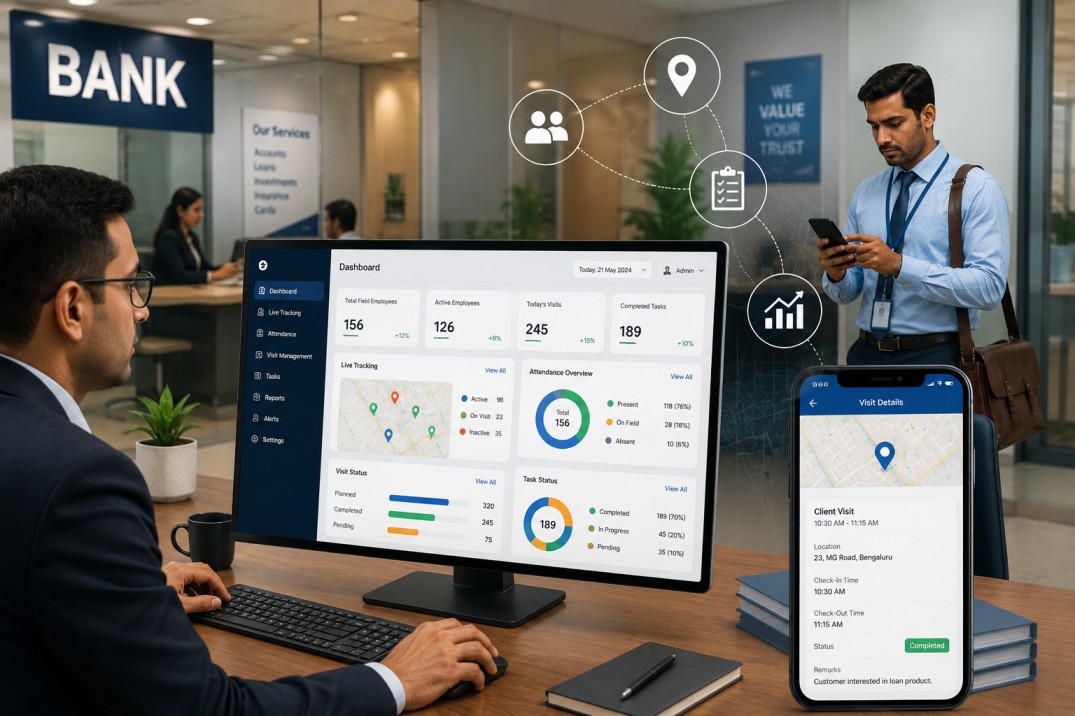
BFSI companies can monitor daily field activities using GPS-based live tracking, geo-tagged attendance, real-time visit logs, task management dashboards, and field force management software. Whether your team handles loan verification, KYC documentation, insurance renewals, or EMI collections, knowing where your agents are, what they are doing, and how long they spend at each location is what keeps your operations moving without blind spots.
Most banks, NBFCs, and insurance companies manage dozens to hundreds of field agents every day. The problem is not the agents, it is the absence of a reliable system to track, record, and act on what happens in the field. This article breaks down exactly how BFSI companies can close that gap.
Field activity monitoring matters in every industry. But in BFSI, the consequences of poor visibility are far more serious.
A missed visit by an FMCG sales rep means a retailer goes without stock for a day. A missed visit by a loan officer means a customer's application stalls, a lead cools off, or worse a fraudulent document goes unchecked.
BFSI field agents handle tasks that directly involve money, legal documents, and regulatory compliance. KYC verification, loan disbursement follow-ups, insurance claim surveys, and debt collection are not routine errands. They require accuracy, accountability, and a verifiable record of what happened.
Yet most organizations still manage this through WhatsApp messages, phone calls, and Excel sheets. That system works until it doesn't and when it fails, it fails badly.
According to a 2024 report by TeamLease, attrition in BFSI customer-facing and field roles runs between 30 to 40 percent. New agents join frequently, experienced ones leave, and without a proper monitoring system, field coverage gaps go unnoticed for days.
The need for structured field activity monitoring is not about distrust. It is about operational discipline that scales.
Banking, financial services, and insurance organizations operate in an environment where customer interactions, compliance requirements, and operational efficiency directly affect business performance. Managing teams across branches, field locations, and customer sites becomes increasingly difficult when employee activities, attendance records, customer visits, and operational updates are spread across multiple systems.
Many BFSI organizations still rely on spreadsheets, phone calls, emails, and manual reporting to track workforce activities. While these methods may work for smaller teams, they often create visibility gaps as operations expand. Managers struggle to understand where employees are working, which customer visits have been completed, what tasks remain pending, and how efficiently teams are utilizing their time.
Staff management software helps solve these challenges by bringing workforce activities into a centralized system. Managers can monitor attendance, track field operations, review visit reports, assign tasks, and access performance data without relying on manual updates. This not only improves accountability but also helps organizations maintain consistent processes across teams and locations.
For banks, NBFCs, insurance companies, and financial service providers, having accurate workforce data supports better decision-making, improves customer service, and creates greater operational control. As field teams grow and customer expectations continue to rise, staff management software becomes an important part of managing daily operations efficiently.
Before building a monitoring system, it helps to understand what your field agents actually do each day. The activities vary significantly by role.
These agents spend their day meeting potential borrowers, verifying property documents, cross-checking application details, and following up on pending approvals. A single loan officer may have 6 to 10 scheduled visits per day across different parts of a city.
Without tracking, there is no way to confirm which visits happened, how long each one lasted, or what was collected or communicated.
Insurance agents handle lead visits, policy presentations, renewal follow-ups, and occasionally claim inspection visits. Their day is unpredictable a customer who confirmed a meeting may cancel, requiring rerouting on the spot.
Real-time visibility allows managers to reassign leads quickly and avoid wasted travel time.
Collection teams follow up on overdue EMIs, outstanding premiums, or pending loan repayments. Their locations, the outcome of each visit, and the time spent are critical operational records especially when a recovery dispute arises later.
These are senior field staff who manage client portfolios, attend meetings, collect documents, and drive cross-sell conversations. Their activity is less predictable and harder to track without structured logging.
Each of these roles creates a different kind of field data. A good monitoring system captures all of it without slowing the agent down.
Most BFSI managers already know something is off. Here is what that usually looks like on the ground.
Agents mark attendance from home, not from their first visit location. Visits get skipped but reported as completed. Travel expense claims do not match any verifiable route. Follow-ups promised in meetings never make it into a record.
Managers rely on end-of-day verbal updates or a WhatsApp message that says "all visits done." There is no way to question it or verify it without making the agent feel accused.
The result is not just productivity loss. It creates compliance risk. If a KYC visit is logged as done but was never conducted, the organization is exposed. If a collection agent claims a visit was made but the borrower disputes it, there is no evidence either way.
According to NASSCOM (2024), over 67 percent of Indian businesses with field teams reported measurable efficiency improvements after adopting field tracking tools. That figure tells you how many were operating in the dark before.
The gap is real. And it is expensive.
This is where most articles give you a vague list of features. Instead, here is how each monitoring method maps to a real operational need in BFSI.
Live GPS tracking shows you where each field agent is at any point during working hours. You can see their movement from the office or home base to the first visit, between clients, and back.
More importantly, you can see deviations. If an agent is supposed to be in Andheri at 11 AM and their GPS shows them in Bandra, that is a conversation worth having.
For collection agents specifically, GPS records also serve as proof of visit which matters if a borrower later claims no one came.
Geo-tagged attendance means an agent can only mark themselves present when they are physically at the designated location. The system records the GPS coordinates at the moment of punch-in.
This eliminates proxy attendance and home-based check-ins entirely. For BFSI field staff management, this single feature alone removes one of the most common monitoring failures.
Every client visit gets logged with a timestamp and GPS pin. The agent checks in when they arrive, fills in visit details, and checks out when they leave.
Managers see the full picture: how many visits were done, how long each one lasted, what was discussed or collected, and what the next action is.
This data is what separates a team that reports activity from a team that proves it.
You can track and manage all of this through visit management feature, which is built for exactly this kind of field workflow.
Managers assign daily tasks each morning through a web dashboard. Agents receive their tasks on a mobile app, mark each one as in-progress or completed, and add notes if needed.
Pending tasks from the previous day carry forward automatically with alerts. Nothing gets silently dropped.
For loan officers or KYC teams with document-heavy workflows, this also creates a paper trail that compliance teams can review.
A loan verification officer needs to capture different information than a collection agent or an insurance renewal executive. Generic field apps do not account for this.
Custom digital forms let you build exactly the data capture flow your team needs property details, KYC checklist, payment collected, client signature, next appointment date, and anything else your process requires.
The data collected during a visit is immediately available to the back office. No scanning documents, no delayed data entry, no information lost in transit.
Travel reimbursements are a consistent source of leakage in BFSI field operations. Without verification, agents can claim more distance than they traveled or submit expenses for visits that never happened.
With GPS-based route verification, the system compares the claimed travel against the actual route taken. Managers can approve or reject claims from the same dashboard without going back and forth over phone calls.
This feature alone often pays for the cost of the monitoring software within a few months.
Field activity monitoring only gives you half the picture if you are not also tracking who is actually on the ground on any given day.
Geo attendance management ties attendance, leave, and field activity together in one place. Managers can see who is present, who is on leave, and who is in the field all from a single dashboard, without making three separate calls to find out.
For BFSI teams operating across multiple cities or regions, this visibility is what allows area managers to plan visit coverage without daily firefighting.
Not every field monitoring app is built for BFSI. Here is what actually matters when evaluating one.
It should work on basic Android smartphones. Most BFSI field agents do not carry high-end devices, and an app that lags or crashes on a mid-range phone will not be adopted.
It should update in real time, not in batch syncs every few hours. If you are looking at location data that is two hours old, it is not monitoring it is history.
It should have an offline mode. Field agents in tier-2 and tier-3 markets often operate in areas with inconsistent network coverage. The app should record data offline and sync when connectivity is restored.
The manager dashboard should be accessible from a web browser. Requiring managers to install an app just to view reports adds friction and reduces adoption.
Role-based access matters. A collection team manager should not see insurance agent data, and vice versa. Data segmentation by team, region, and role keeps information clean and secure.
Data security is non-negotiable. BFSI companies handle sensitive client financial data. The platform needs to meet basic security standards and handle data responsibly.
India's BFSI sector is projected to need 1.6 to 2 million additional skilled professionals by 2025, according to a report by Hunar.ai. As field teams scale at this pace, any monitoring system that depends on manual inputs will collapse under its own weight. Only a software-based approach can keep up.
Most BFSI managers associate field monitoring with catching agents who are not working. That framing misses most of the value.
When you have reliable data on field activities, you can see which agents consistently convert visits into applications and which ones do not. You can identify whether low conversion is a skill problem or a territory problem. You can see how much time is being lost to travel versus productive client time.
That data tells you where to train, where to reallocate, and where to improve the process itself.
Real-time field data also speeds up back-office decisions. When a loan officer completes a verification visit and submits digital notes instantly, the processing team can act the same day instead of waiting for a physical file to arrive.
For collection teams, real-time visit logs mean supervisors can follow up the same day if a high-priority account was not visited rather than discovering the gap a week later.
Monitoring done right is not surveillance. It is operational intelligence that makes everyone's job easier.
Getting the technology right is only part of it. Here are the mistakes that prevent monitoring from working even when the software is in place.
Buying complex enterprise software that agents refuse to use. If the app takes 10 minutes to check in for a visit, agents will find workarounds. Simplicity drives adoption.
Monitoring attendance while ignoring visit quality. Knowing that an agent was at a location for 45 minutes tells you less than knowing what was discussed, what documents were collected, and what the next step is.
Not training managers to act on dashboard data. Reports are only valuable if someone reads them and does something. Many organizations set up monitoring and then never build the habit of reviewing it.
Setting uniform daily visit targets across geographies. An agent covering dense Mumbai lanes can complete 12 visits in a day. An agent covering rural Maharashtra cannot. Targets that ignore geography create pressure without producing results.
Not customizing the tool for BFSI workflows. A generic field force app will give you location data. A BFSI-configured tool will give you KYC status, document collection confirmations, and loan stage updates alongside that location data. The difference is significant.
Here is what a well-monitored BFSI field day looks like in practice.
The manager logs into the dashboard each morning, assigns visits and tasks to agents based on the day's priorities, and reviews pending items from the previous day.
Agents receive their tasks on their phones, check in at their first location with geo-tagged attendance, and begin visits. Each visit is logged with check-in, visit notes through a custom form, and check-out.
The manager tracks live locations throughout the day. Any agent who is off-route or has stopped for an unusually long time gets a quick check-in call.
By end of day, the manager has a full report: visits completed, tasks pending, expenses logged, and any customer actions that require back-office follow-up.
No WhatsApp threads. No end-of-day guessing. Just accurate, timestamped data.
1. What are daily field activities in the BFSI industry?
Daily field activities in the BFSI industry include customer visits, KYC verification, document collection, loan application verification, insurance policy renewals, debt collection, account servicing, and client relationship management.
2. Why is field activity monitoring important for banks and financial institutions?
Field activity monitoring helps organizations improve employee accountability, verify customer visits, reduce operational gaps, maintain compliance standards, and ensure important tasks are completed on time.
3. What challenges do BFSI companies face when managing field teams?
Common challenges include lack of real-time visibility, inaccurate attendance reporting, missed customer visits, delayed follow-ups, inefficient communication, and difficulty tracking employee productivity across multiple locations.
4. How can GPS tracking improve field workforce management?
GPS tracking provides real-time visibility into employee movements, helps verify customer visits, improves route planning, and allows managers to monitor field operations more effectively.
5. What is geo-tagged attendance and how does it work?
Geo-tagged attendance records an employee's location when they mark attendance. This helps organizations confirm that employees are physically present at their assigned work location or customer site.
6. How do banks verify customer visits completed by field employees?
Banks often use visit logs, GPS location records, digital check-ins, customer confirmations, and activity reports to verify that scheduled visits have been completed.
7. What information should be recorded during a field visit?
A field visit record should include visit time, location, customer details, purpose of the visit, documents collected, discussion summary, and required follow-up actions.
8. How can BFSI organizations reduce missed customer follow-ups?
Organizations can reduce missed follow-ups by using task management systems, automated reminders, centralized customer records, and real-time activity tracking.
9. What role does technology play in managing field operations?
Technology helps automate attendance tracking, visit reporting, task assignment, expense management, communication, and performance monitoring, making field operations more organized and transparent.
10. What metrics should managers track to evaluate field team performance?
Managers commonly track customer visits completed, attendance rates, follow-up completion rates, response times, travel efficiency, task completion rates, and customer engagement activities.
Monitoring daily field activities in BFSI is not optional if you are serious about productivity, compliance, and customer service quality. It is the difference between managing a team and just hoping they are doing their jobs.
GPS tracking, geo attendance, visit logs, task assignment, custom forms, and expense verification each solve a specific operational problem. Together, they give BFSI companies the visibility they need to make fast, confident decisions whether that is reassigning a lead, approving an expense, or identifying a high-performing agent worth investing in.
For BFSI companies looking to build that visibility without complicated setup or long onboarding, UpTeams is built for exactly this. From loan officer and insurance agent tracking to collection team management and custom KYC forms, it brings your entire field operation into one place and gives your managers the control they have always needed.
Start your free trial and see what your field team is actually doing, every day.
Start your free trial today