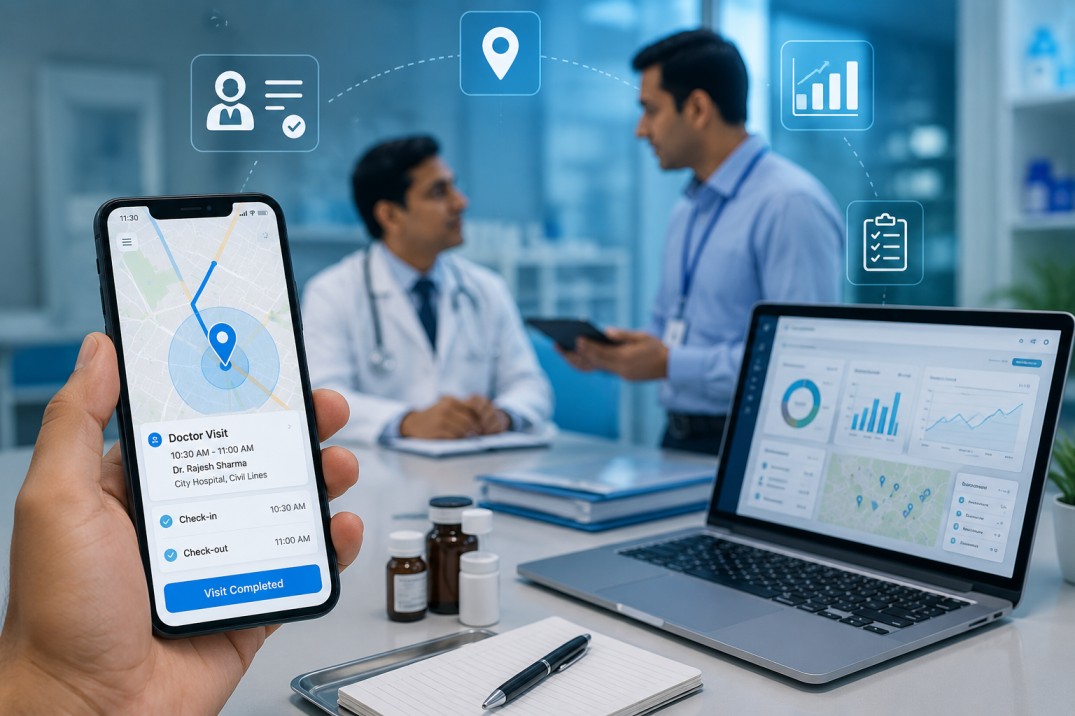
Pharmaceutical companies track medical representatives through a mix of GPS-based location tracking, digital daily call reports, geo-attendance, and CRM records of every doctor and chemist visit. Almost all of this now runs through a single mobile app instead of the phone calls and paper diaries that field teams used for decades. The goal isn't to watch every move an MR makes. It's to know whether visits actually happened, whether territories are getting covered the way they're supposed to, and whether the money spent on a field force is producing results.
Ask any Regional Sales Manager who's been in pharma for more than ten years, and they'll tell you the shift happened faster than expected. Ten years ago, an MR would call their manager in the evening and read out a list of doctors visited that day. Today, that same manager can open a dashboard at 11 AM and see exactly which clinic an MR checked into an hour earlier.
This article breaks down what's actually tracked, how the tools work, why companies invest in this in the first place, and where most implementations go wrong.
Before going further, it helps to separate two things that get confused constantly: surveillance and visibility.
Surveillance is watching someone's every move for the sake of control. Visibility is knowing enough to manage a team well. Most MRs assume tracking software falls into the first category, and honestly, some poorly implemented systems do lean that way. But the intent behind most pharma tracking tools is closer to the second.
What companies genuinely want to know is simple:
Did the visit happen?
Where and when?
What was discussed with the doctor or chemist?
Were samples or literature handed over?
Is the MR covering the territory the way the tour plan says they should?
None of that requires knowing what an MR had for lunch or how long they sat in traffic. It requires proof of a visit and a record of what happened during it.
This distinction matters more than it sounds. Field teams that understand tracking exists to support performance reviews and territory planning tend to adopt these tools without much resistance. Teams that feel like they're being policed push back, game the system, or quietly stop trusting management. The difference usually comes down to how the rollout was explained, not the technology itself.
Pharma is one of the few industries where the sales team almost never sits in an office. An MR's entire job happens across clinics, hospitals, and chemist shops spread over a district or a city. That creates a management problem that other industries don't deal with in quite the same way.
Territory coverage is the big one. Doctors are usually classified by prescribing potential, and higher-potential doctors need to be visited more often. If an MR skips a high-value doctor for three weeks straight, that's a direct hit to prescription generation, and by the time it shows up in sales numbers, the damage is already done. Tracking data catches this early instead of a month later.
Compliance pressure is real too. Pharmaceutical marketing in India operates under codes like the Uniform Code for Pharmaceutical Marketing Practices (UCPMP), which set expectations around how companies engage with healthcare professionals. Having a documented record of visits, discussions, and materials shared gives companies something to point to if their practices are ever questioned.
Then there's the cost angle. A field force is one of the largest recurring expenses in a pharma company's sales and marketing budget once you add up salaries, travel allowances, and incentives. Leadership wants to know that spend is translating into actual doctor engagement, not just kilometers logged on an expense sheet.
Span of control is the last piece. A single Area Sales Manager often oversees eight to twelve MRs spread across a wide geography. Reviewing that many people's daily activity by phone call alone simply doesn't scale. Data does the heavy lifting that manual check-ins used to attempt and mostly failed at.
It's worth spending a moment on how things used to work, because it explains why the shift to digital tracking happened as quickly as it did.
MRs filled out Daily Call Reports (DCRs) on paper, usually at the end of the day, often from memory rather than in real time. Monthly tour programs were planned on Excel sheets and rarely cross-checked against what actually happened in the field. Managers relied on phone calls for daily updates, which meant they got whatever version of the day an MR chose to share.
The problems with this system were obvious to anyone who worked in it:
Reports were frequently backdated or filled in days later
There was no real way to confirm a visit had actually taken place
Reconciling tour plans against actual coverage during audits was a nightmare
Data lived in scattered notebooks, spreadsheets, and someone's memory
As companies scaled their field teams into hundreds or thousands of MRs across the country, this manual approach simply stopped working. The volume of data became too large to manage by hand, and the accuracy problems became too expensive to ignore.
This is where most of the actual change has happened over the last several years, and it's worth breaking down piece by piece rather than lumping it all together as "an app."
Real-time location capture during a visit confirms an MR was physically near the clinic or chemist shop they claim to have visited. Many systems use geofencing, which draws a virtual boundary around a location and only allows a check-in when the MR's device is actually within that boundary. Route history for the day also gives managers a clean audit trail without needing to ask.
The paper DCR has largely been replaced by app-based reporting. An MR logs the doctor's name, specialty, discussion points, samples handed over, and the next planned follow-up, all from their phone right after the meeting. Some systems even capture a photo or a signature as additional proof that a visit took place, which matters during internal audits.
Attendance tied to location, rather than a manual entry typed in at any time of day, removes a common source of dispute. This matters more in pharma than people realize, since MRs often work across multiple towns within a single week and attendance disagreements used to eat up a surprising amount of a manager's time.
Instead of every MR keeping their own notebook of doctor details, companies now maintain a shared database of healthcare professionals. This includes visit history, prescribing notes, and relationship context, which becomes valuable when an MR leaves the company or gets reassigned to a new territory. The institutional knowledge stays with the company instead of walking out the door.
Monthly tour programs are mapped out in advance and compared against actual visits as the month progresses. This lets a manager spot a coverage gap in week two instead of discovering it during a month-end review, when there's no time left to fix it.
Travel claims and daily allowances get cross-checked against actual logged visits rather than being approved on trust alone. This cuts down on disputed reimbursements and gives finance teams a cleaner paper trail.
Once the data starts flowing, it usually gets boiled down into a handful of numbers that matter most to sales leadership:
Call average — the number of doctor and chemist visits completed per day
Coverage percentage — how many of the planned healthcare professionals were actually visited within the reporting cycle
Visit frequency per doctor — matched against the doctor's assigned tier or prescribing potential
Product-wise detailing ratio — how an MR's time is split across the portfolio they're promoting
Sample and literature distribution — what was actually handed out during visits
Territory-wise sales correlation — how visit patterns line up with actual prescription and sales trends
Attendance and punctuality trends — a smaller factor, but still tracked for HR purposes
The metrics tell managers something more useful than just whether an MR is working. They show whether MR is working on the right things, in the right places, for the right doctors.
For anyone unfamiliar with how this actually plays out on a normal working day, it looks roughly like this:
The MR arrives at a doctor's clinic or a chemist shop and checks in through the app, which captures GPS location and a timestamp
The MR fills in the DCR right there which doctor was met, what was discussed, what samples were given
That data syncs to a central dashboard, often within seconds if there's a network connection
The manager reviews the day's visits against the planned tour program, usually without needing to call anyone
Over a month or a quarter, individual visit records roll up into performance summaries that feed into incentive calculations and appraisals
The one wrinkle worth mentioning is connectivity. In rural areas or smaller towns where network coverage is patchy, most decent systems allow offline data entry that syncs automatically once the device reconnects. Without this, field teams in tier two and tier three markets would be at a constant disadvantage compared to MRs working in metro cities.
None of this is as smooth in practice as it sounds on paper, and it's worth being honest about where things break down.
Fake or proxy check-ins happen more than companies would like to admit. An MR might mark a visit as complete without actually meeting the doctor, especially if they're behind on their tour plan and trying to catch up on paper.
Resistance from field staff is common in the early months of any rollout. Nobody enjoys the feeling of being watched, and if the transition isn't communicated well, MRs assume the worst about why the tool exists.
Network gaps in smaller towns and rural belts genuinely slow down real-time data capture, even with offline modes in place.
Tool fragmentation is a quieter but expensive problem. Some companies end up running separate systems for attendance, expense claims, and visit reporting, which means MRs enter the same information multiple times and managers have to stitch together data from three different places to get a full picture.
Data overload without action is probably the most underrated challenge. Plenty of companies collect enormous amounts of field data and never build a habit of actually reviewing it or acting on what it shows.
A few patterns show up again and again in failed or half-successful rollouts:
Introducing the tool without explaining why it exists, which almost guarantees pushback from the field team
Over-monitoring every small detail instead of focusing on outcomes like coverage and call averages
Picking a generic logistics or delivery tracking tool and forcing pharma workflows onto something that wasn't built for doctor visits, samples, or DCRs
Ignoring feedback from MRs about how clunky or slow an app feels to use, which quietly kills adoption over a few months
Failing to connect tracking data to incentives, so MRs see no personal upside in reporting accurately
Companies that avoid these mistakes tend to get much higher adoption rates within the first quarter of rollout, simply because the field team can see the tool is actually useful to them, not just to management.
It's easy to frame this entire topic as something management imposes on the field force. That's only half the picture.
For management, the upside is fairly direct: accurate territory coverage data, easier compliance audits when questions come up, better forecasting because it's tied to real field activity rather than assumptions, and incentive calculations that are backed by data instead of self-reported claims.
For medical representatives, the benefits are less talked about but genuinely matter. There's far less paperwork, since nobody has to sit down at 9 PM trying to remember what happened at each of eight visits earlier that day. There's a clean, transparent record of work that helps during appraisal conversations, especially if there's ever a disagreement about performance. And there's visibility into their own numbers against their targets, which a lot of MRs actually appreciate once they get used to it.
Pharmaceutical marketing in India operates under industry codes like the UCPMP, issued by the Department of Pharmaceuticals, which set expectations around how companies and their field teams engage with doctors and other healthcare professionals. Having a documented, timestamped record of visits and what was discussed gives companies something concrete to reference if their marketing practices are ever reviewed.
This isn't a legal deep-dive, and companies should check the current text of these codes directly through official government or industry association channels rather than relying on secondhand summaries. But the general point stands: structured visit records support compliance efforts far better than memory-based reporting ever could.
For companies evaluating tools, a few features separate the ones that actually get used from the ones that end up abandoned within a few months:
Real-time GPS and geo-attendance, not just an end-of-day summary that could have been typed from anywhere
Fast DCR entry that takes an MR one or two minutes per visit, not five
Offline mode that works properly in low-network areas and syncs automatically later
Custom forms for different visit types, since a doctor visit, a chemist visit, and a stockist visit all need slightly different information captured
Built-in route and tour planning, rather than a separate spreadsheet that nobody keeps updated
Dashboards managers can actually read without needing a training session just to interpret the numbers
A field-specific tool built around these exact requirements, such as the pharma reporting app from UpTeams, tends to fit this use case more naturally than a generic sales tracking platform, largely because visit reporting, geo-attendance, and route planning are handled as one connected workflow instead of three separate systems bolted together.
MR tracking has moved from being a compliance checkbox to something closer to a genuine management tool. The direction seems to be shifting further still, away from monitoring purely for the sake of oversight and toward monitoring that actually helps MRs work better, get paid fairly, and spend less time on paperwork they never liked doing anyway.
Companies that get this right tend to treat tracking as a two-way exchange. Management gets the visibility it needs, and MRs get less admin work and a fairer, data-backed record of their performance. That combination is what actually drives long-term adoption, more than any single feature of the software. UpTeams provides pharma reporting tools around exactly this balance, aiming to give field teams a system that works for them as much as it works for the managers reviewing their numbers.
Most pharmaceutical companies use mobile-based MR tracking software that combines GPS location tracking, geo-attendance, digital Daily Call Reports (DCR), CRM records, and route planning. These tools help managers verify doctor visits, monitor territory coverage, and improve field sales performance.
GPS tracking helps confirm that medical representatives visit the doctors, hospitals, and chemists assigned to them. It also improves route planning, reduces manual reporting, and provides managers with accurate field activity data.
A Daily Call Report (DCR) is a record of a medical representative's daily visits. It includes details such as the doctors or chemists visited, discussion points, products promoted, samples distributed, and follow-up actions. Today, most companies use digital DCRs through mobile apps instead of paper reports.
Yes. Pharmaceutical companies can track medical representatives for business purposes, provided they follow applicable privacy laws and company policies. Tracking is generally used to manage field operations, verify visits, improve productivity, and support compliance rather than monitor personal activities.
An effective pharma MR tracking solution should include GPS tracking, geo-attendance, digital DCR management, doctor and chemist databases, tour planning, offline data capture, expense management, reporting dashboards, and CRM integration to streamline field operations.
MR tracking software helps improve sales performance by ensuring better doctor coverage, reducing missed visits, simplifying reporting, providing real-time performance insights, and helping managers make informed decisions based on accurate field data.
Yes. Many modern pharma reporting applications support offline functionality. Medical representatives can record visits, complete DCRs, and capture attendance without internet access. The data automatically syncs with the central system once the device reconnects.
Digital DCRs save time, reduce paperwork, improve reporting accuracy, eliminate duplicate entries, provide real-time updates, and make it easier for managers to review field activities and generate performance reports.
Companies typically evaluate medical representatives using key performance indicators (KPIs) such as daily call averages, doctor coverage, visit frequency, territory coverage, product detailing, sample distribution, sales performance, and adherence to planned tour schedules.
When selecting MR tracking software, look for a solution designed specifically for pharmaceutical field teams. It should offer GPS-enabled visit tracking, fast digital DCR entry, offline support, doctor and chemist CRM, route planning, real-time dashboards, attendance management, and detailed reporting to improve field productivity and decision-making.
Start your free trial today